Doing Nothing Has a Great Win Rate

James Keal
Short on time?
Get a quick summary in your LLM, or watch this article as a Hyperframe.
Most useful business videos don't get rejected. They just never get made. No one picks a rival platform, no one signs off a cheaper agency, no one holds a meeting to kill the idea. The client meeting, the webinar or the campaign simply goes ahead without a video, and nobody notices the gap where one could have been.
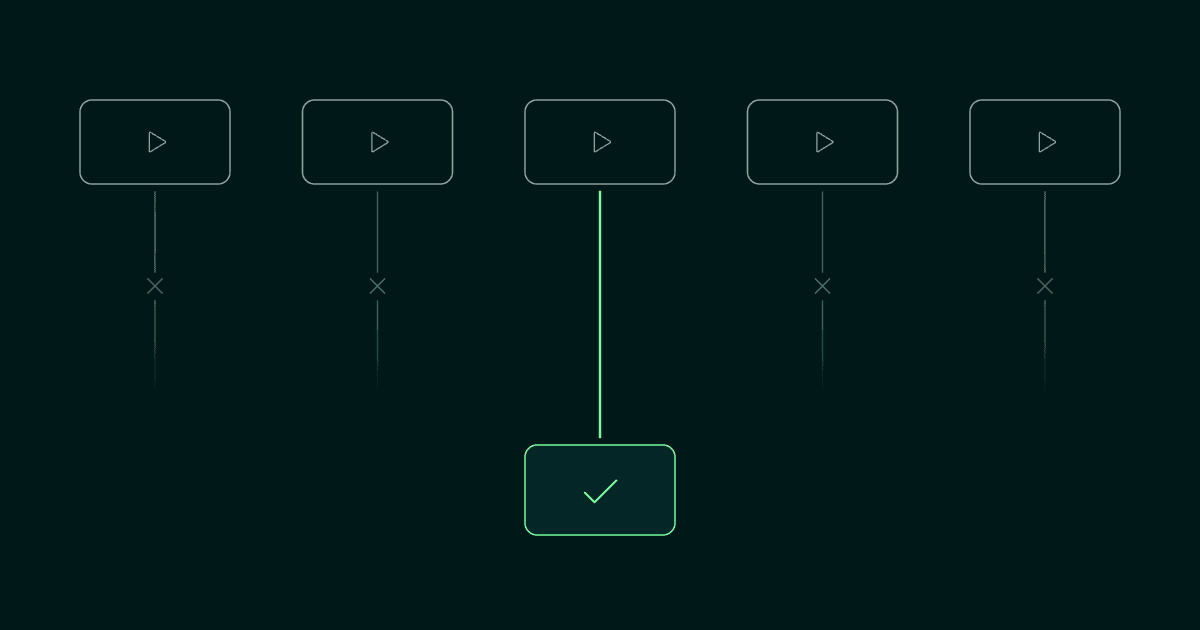
For most business moments that could have used a video, the contest was never tool against tool. It was making the video against doing nothing, and doing nothing has a very good win rate.
Doing nothing wins by default
Doing nothing wins because the alternative is priced and paced for a completely different kind of decision. A two-minute corporate video runs $2,000 to $20,000 through traditional production, with the average job landing between $8,000 and $15,000 once you add scripting, a crew and post, according to Vidico's 2026 pricing guide. Timelines run four to eight weeks from concept to delivery, and the studios themselves will tell you the biggest delay isn't filming. It's waiting on internal feedback and sign-off.
Longer numbers you'll see quoted measure a different thing. Clutch's client-reported data puts the typical timeline at five months, but that figure covers the full project lifecycle, brief to final delivery with every internal sign-off cycle counted in, not the production stretch. Put the two side by side and the distance between four to eight weeks of actual production and five months of elapsed time is almost all approval friction, which is the whole problem.
Pricing is opaque enough that just comparing quotes takes real effort, because agencies bundle pre-production, revisions and usage rights differently, with no shared standard to line them up against.
Now hold all of that against the moments where a video would actually help. A client meeting next week. A webinar in ten days. A campaign launching next month. A multi-week process starting at several thousand pounds doesn't fit any of them. The moment passes, and the default outcome isn't a cheaper video. It's no video.
One flagship project sets the price for every other
The real damage is that a single expensive video quietly reprices every idea that comes after it. Once it defines what "making a video" means inside an organisation, its price tag becomes the yardstick.
We watched this from the agency side, and it's worth being precise about it. This wasn't our project and around £100,000 wasn't our fee. An enterprise client had paid another supplier roughly that much for a five-screen interactive experience: custom brand animation, clickable overlays, the lot. We saw the number as onlookers and thought it was mad. PowerPoint and a good freelancer would have reached the same outcome for a fraction of it.
The flagship gets made once. The fifty smaller, genuinely useful videos that same year, the client explainer, the proposal walkthrough, the internal update, get measured against a six-figure memory and a months-long process. Then they die in the comparison. Nobody votes against them in a meeting. They just never become projects.
Get the next piece by email.
One email when we publish. Unsubscribe anytime.
There's a name for this, and the research is old
Status quo bias is one of the better-documented findings in decision research. In their 1988 study in the Journal of Risk and Uncertainty, William Samuelson and Richard Zeckhauser showed that people stick with the current state, doing nothing or repeating a past choice, even when switching would plainly serve them better. They tested it on real, consequential decisions, including how faculty chose health plans and retirement funds, and the pull toward standing still held up.
One of their findings does most of the work here: we feel sharper regret over a bad outcome we caused than over an equally bad one we merely allowed. Inside a large organisation, that asymmetry has teeth. Approving the video means putting your name on a budget line and owning whatever comes back from it. Doing nothing means owning none of it. A video that gets made and turns out mediocre is a decision someone signed, sitting in the open with an author. A video that never gets made belongs to no one and shows up on no one's review.
Offered a visible misstep or an invisible gap, most people take the gap every time. Status quo bias is strongest exactly where the cost of inaction is spread thin and the cost of a wrong move has a face on it. In a big enough organisation, that describes most decisions.
The category is arguing about the wrong fight
Almost all coverage of video tools, AI or traditional, frames the category as tool against tool. This platform versus that one, this agency's feature grid against another's. That framing quietly assumes the buyer has already decided to make a video and is only choosing how.
For most of the videos that never happen, that decision was never made. The thing that actually settled it came earlier and quieter: whether to start at all, given the cost, the weeks and the approval chain sitting between a good reason and a finished file.
The number that matters is activation energy
If the real competitor is inertia, the comparison worth having isn't rendering quality against the next platform. It's activation energy: how much cost, time and approval friction sits between someone having a genuinely good reason to make a video and that video existing.
A tool that renders slightly nicer than its rival but still needs the same weeks of approval and production hasn't changed whether the video gets made. It's fighting over a small pool of buyers who were always going to make one somehow. A tool that genuinely lowers the cost and the time changes who even attempts it, which is a different and much larger opportunity than winning share from other software.
Show an organisation a real cost saving and people listen. Show them the specific video that would have helped last quarter and didn't happen, and they listen harder. That second pool, the moments that currently default to nothing, is where nearly all the lost value sits. And it stays invisible to a category that only ever talks about itself next to its nearest competitor.
Nothing wins by default, but default isn't the same as undefeated. Once you treat inertia as the real competitor, the work changes. It stops being about rendering a nicer video than the next platform and starts being about removing the cost, the weeks and the sign-offs that make doing nothing the path of least resistance. Take enough of that friction out and the videos that used to quietly never happen start to. That's the pool nobody is really competing for, and it's the only one worth winning.